Current & Previous Projects

Instructional Design
-
Opportunity: As the online education coordinator, I led the digital learning initiative on campus to provide robust faculty training in delivering online instruction.
My role: I designed, developed, and delivered an Online Instruction Certification (OIC) training program for faculty and collaborated with senior leaders to drive buy-in and institutional support for faculty participation.
Final Deliverable: View information about the OIC on the CSUMB Academic Technology website.
-
Opportunity: Each summer, the Center for Academic Technologies has the opportunity to develop courses for faculty development related to educational technology and online teaching. In 2023, Artificial Intelligence (AI) was the trending topic, but the webinars were getting repetitive, and faculty concerns were at an all-time high related to academic integrity and the inappropriate use of AI in the classroom.
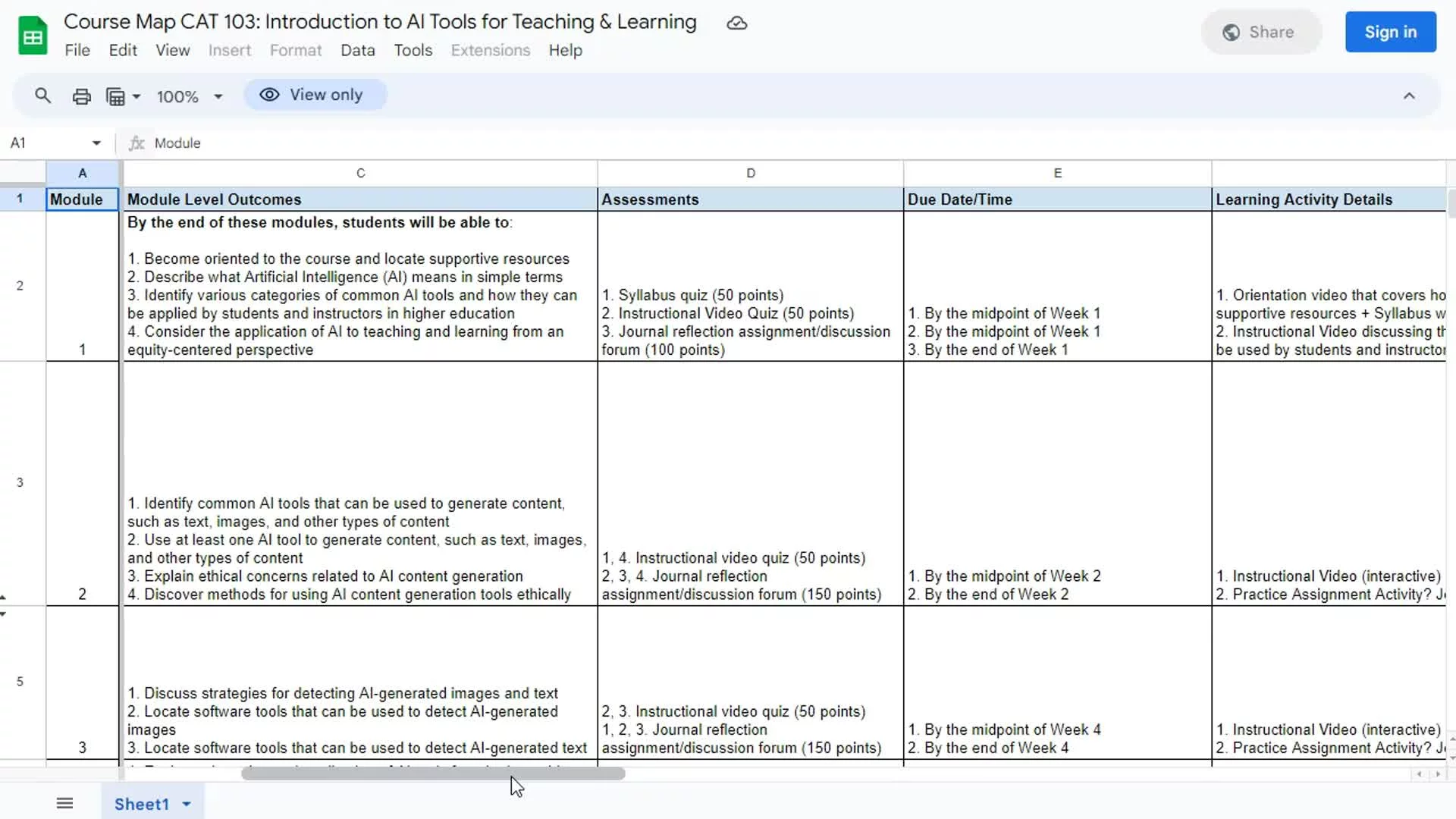
My role: As an instructional designer, I developed and facilitated a Summer Institute course that emphasized ethical exploration and experiential learning. I knew that the more faculty experimented with AI tools, the better they would understand the limitations and potential uses of AI. Ultimately, there were over 110 successful faculty course completions in the two-week cohort. My course development process took approximately six months, and I started by developing the course map (linked below as a deliverable). The course mapping process involved the creation of scaffolded learning outcomes aligned with Bloom’s Taxonomy, and was based on a needs analysis process that involved analyzing faculty concerns (local and those voiced in trade publications, forums, and other organizations), current market research, trend forecasting, and hands-on experience with emerging AI technologies related to my work as a creative writer (cover design). After the outcomes were developed, the assessments were designed, then the learning activities, resources, and more were created through a backward design process to ensure instructional alignment. I participated in many courses, webinars, forums, and conversations with peers and colleagues, which resulted in many collaboratively-sourced resources that ultimately greatly enhanced the quality of the course.
Final Deliverable: View the course map (a recorded course tour may be available by request, and a list of external institutions that have adopted this course is also available by request.)
-
Opportunity: In 2019, Hartnell College was awarded over $30,000 to spend on Classified Staff Professional Development.
My role: I volunteered to join the committee tasked with managing those funds, and was elected chair. As chair, I led the process of designing a new program that we called the Classified Staff Leadership Academy. The primary purpose of the funding was to provide career laddering and professional development programming for classified staff, and we essentially followed a backward design process for the Academy: we assessed the managerial job descriptions across the district, identified similar requirements across all management classifications, and designed an academy that would help staff gain those specific skills so they would be prepared for leadership positions in our district.
Final Deliverable: Hartnell College Classified Leadership Academy Program (if the link no longer works, request a copy of the archived webpage.)
Faculty & Staff Development
-
Opportunity: As an assistant professor building new courses in the new MSIDT program, I could bring in current practices and tools to demonstrate field deliverables.
My role: As the course developer and facilitator, I created weekly microlearning activities using Articulate and Vyond.
Deliverable: Here is one example of an Articulate Rise SCORM package centered around teaching ID models.
-
Opportunity: This instructional video was designed to promote the faculty development course titled “Introduction to Artificial Intelligence Tools for Teaching and Learning”, which was rolled out for Summer Institute in 2023. After receiving a great deal of interest from institutions locally, then globally, a video was developed to distribute to those interested in learning what the AI course was all about. This helped manage the requests for information about the course.
My role: As the developer and facilitator of the AI course, I was able to freely distribute the course with my supervisor’s support. I belonged to several AI research and resource communities and used those opportunities to share the course with the wider community when there was surging interest in training faculty in emerging AI technologies.
Final Deliverable: View the AI course promotional video online.
-
Opportunity: A new mobile app was made available for students to register for classes, make counseling appointments, make payments, and connect with the campus in multiple other ways. Students, staff, and faculty had to be made aware of the new app and how it could make life easier.
My role: I was directed to create a written job aid, which could be put on display in the student center during an upcoming event. I used this as an opportunity to create a micro-training video, which featured a smartphone screen that showcased the new app and summarized its capabilities in large text along the side. To create the video, I used a smartphone video stock footage as the frame, then used Zoom to share my own smartphone’s screen while completing basic tasks in the new app. I recorded my phone screen and inserted it into the stock video frame for a seamless final video product.
Final Deliverable: View the Hartnell app promotional video online.
Conference Presentations
Change Management
-
Opportunity: After various instructors engaged in the CSUMB AI Summer course, leaders in the California State University system voiced interest in adopting the same course and rolling it out CSU-wide.
My role: As the course author, I made it available to the CSU and provided recommendations and support for scaling it for CSU-wide deployment. I worked with stakeholders in the Chancellor’s Office to collaboratively identify and train instructors across the CSU to facilitate sections (10 sections to start) and updated the course annually (2023-2025) to ensure the content was up-to-date.
Final Deliverable: View the Introduction to Teaching with AI on the CSU AI commons webpage. Thousands have successfully completed the course.
-
Opportunity: The CSU Chancellor’s Office offers grant funding to drive the adoption of quality online teaching frameworks on campus.
My role: As the campus Online Education Coordinator, I proposed a program in alignment with University initiatives and grant requirements to incentivize faculty participation in Quality Matters (QM) training to increase institutional knowledge and skills in quality online course best practices.
Final Deliverable: The grant was awarded and met all goals for AY 2022-23 and 2023-24. Additionally, an expanded program was proposed and awarded for 2025. View the institutional Quality Matters program report archive.
-
Opportunity: In 2015, all colleges within the California Community College system received full funding through the Online Education Initiative (OEI) for Canvas as a centralized Learning Management System (LMS).
My role: As the instructional technologist and campus LMS administrator, I managed the pilot program, developed customized Canvas training, supported course data exports and imports, served on key governance committees to communicate with stakeholders about the transition process and planning, and collaborated with programming staff to integrate Canvas with various campus systems.
Final Deliverable: By 2016, the campus had successfully transitioned to the Canvas LMS.
This video was created to promote the 2023 Summer Institute faculty training course.